
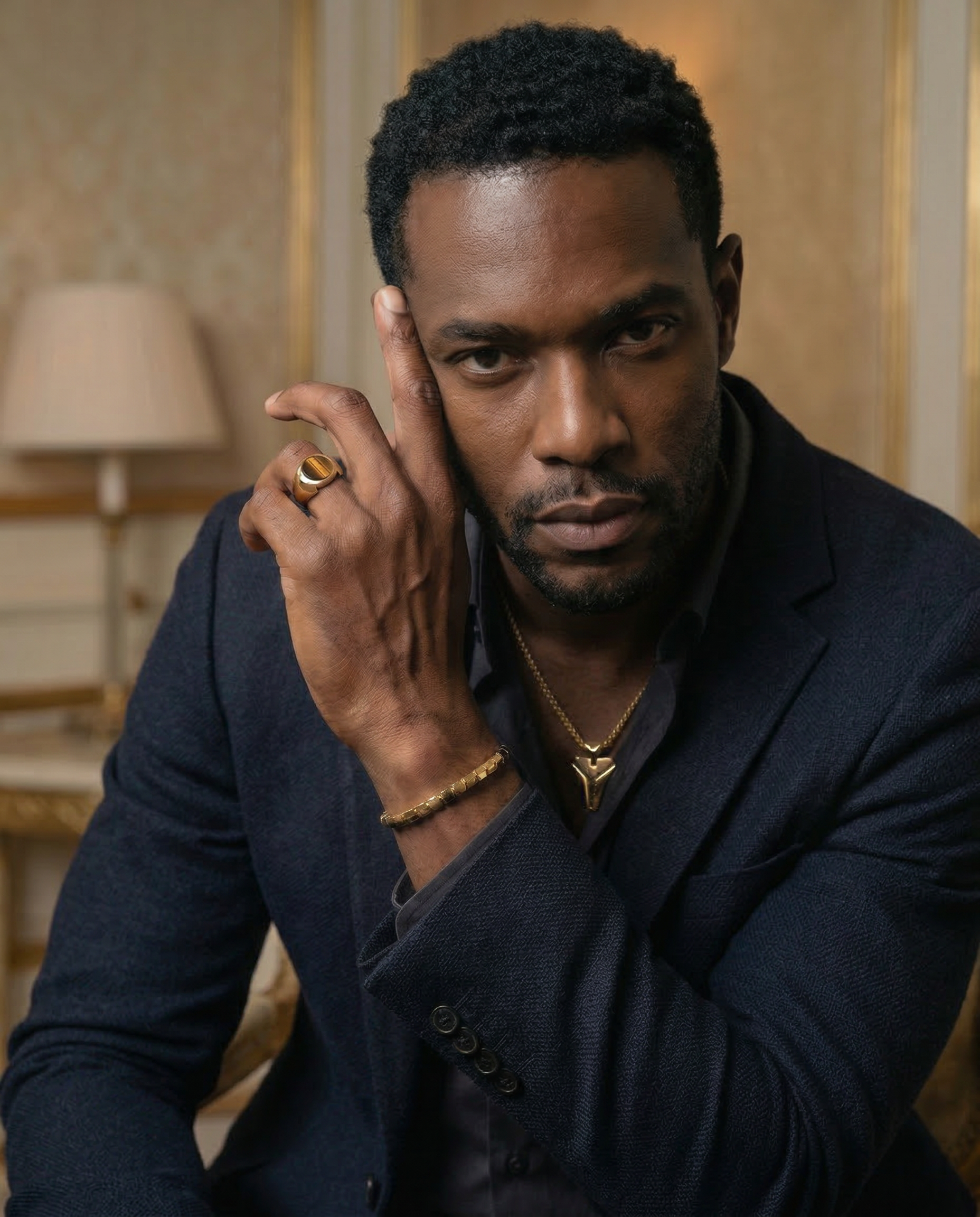
"Marcus Aurelius wrote his Meditations at dawn. Not for readers. Not for posterity. For himself."
Every morning, before the empire could reach him, he sat with a blank page and rehearsed who he intended to be that day. He was not journaling. He was arming himself.
Two thousand years later, most men skip this step entirely. They roll over, reach for the phone, and hand the next sixteen hours to whoever gets there first—the inbox, the algorithm, the group chat. By 9am they have already been reacting for three hours.
There is a simpler version of what Marcus did. It requires no journal, no app, no fifteen-minute meditation practice. It takes two minutes. And if you already own a Seekers piece, you have the only tool you need.
01. What Actually Happens When You Put On Jewelry
Most men think of jewelry as decoration. Something to complement a shirt collar. Something to catch light at dinner.
But watch a man who wears the same piece every day—really watch him—and you will notice a tell. He touches it without thinking. In the middle of a sentence. While reading. While deciding. His hand drifts to his wrist or his neck and rests there for a moment, then returns to whatever it was doing.
That is not vanity. That is anchoring.
Neuroscience calls it contextual cueing: your brain associates physical sensations with mental states. A runner laces up her shoes and her nervous system shifts before the first stride. A surgeon pulls on gloves and enters a different cognitive mode. A chef ties the apron and the kitchen sharpens around him. The object does not cause the state. The object reminds the brain which state to enter.
The piece on your wrist can do the same thing—if you let it.
The 2-Minute Ritual
Four steps. Two minutes. One intention.
Do not just slip it on while scrolling email. Pause. Hold the piece in your hand. Feel the weight, the temperature, the texture against your palm. This moment of stillness is the entire point—the transition from reaction to intention. From unconscious to deliberate. Without the pause, it is just an accessory. With the pause, it is a practice.
One word that describes the man you intend to be today. Not the man you are. The man you intend to be.
Steady—for days when everything pulls. When composure is the only weapon that works.
Sharp—for first meetings, pivotal decisions, the hours when precision matters more than warmth.
Patient—for the long game. For children. For letting a plan unfold instead of forcing it.
Grounded—when you are far from home. When you have lost the thread. When you need to remember what you stand on.
Clasp it slowly. Slide it on as though you are marking a threshold—because you are. You are crossing from the man who was asleep five minutes ago into the man who chose a word. The piece is no longer decoration. It is evidence that you meant what you just said.
Wear it. Forget it. And then, midway through the afternoon, when the meeting runs long and the patience wears thin—touch it. Feel the weight. The word comes back. The intention comes back. You come back.
02. Why This Is Not "Woo"
I know the objection. Setting intentions sounds like incense and sound baths. This is none of that. This is James Clear’s identity-based habits framework applied to a physical object.
When you repeat a behavior attached to a specific trigger, you are not manifesting anything. You are training your brain to recognise a cue and respond with a desired state.
You do not quit smoking because you want to quit. You quit because you stop identifying as a smoker. You do not start running because it is healthy. You start because you become a runner. Same mechanism. The piece becomes the cue. The word becomes the identity.
No crystals. No chakras. Just a habit loop with a physical anchor.
03. The 3,000-Year-Old Version
This practice is not new. It is older than philosophy. In Greece, men carry komboloi. Across the Middle East, the tasbih. In South Asia, malas. Small object. Large intention.
In Rome, men wore signet rings engraved with family crests and oaths. Even Marcus Aurelius carried a memento mori coin. Every time he felt its edge in his pocket, the thought returned. Not as dread. As clarity.
"A small, physical object carried every day. Touched repeatedly. That stands for something bigger than itself."
04. Different Stones for Different Days
Onyx and hematite—dark, heavy, grounding. For focus. For saying less and meaning more.
Tiger eye—warm, striated, bold. For courage. For the hard conversation you have been postponing.
Lava stone—matte, porous, forgiving. For reset. For travel. For shedding yesterday so you can start clean.
Clear quartz and steel—bright, sharp, precise. For clarity. For hard decisions. For knowing what matters and cutting away the rest.
Not because the stone does anything. Because when you pick a stone for a specific intention, the stone becomes the anchor. Every time the word returns, the intention returns.
How to Actually Stick With It
- 1. Stack it onto something you already do: Brush your teeth, then do the ritual. Pour the coffee, then pick the word.
- 2. Do not skip the pause: The ten seconds before is where the entire practice lives. Rush it and it becomes nothing.
- 3. Keep it private: Do not tell people. This is not for an audience. It is for you.
- 4. Let it evolve: Some months you will wear the same word. Some seasons will call for a different piece entirely.
The piece is not the point. The ritual is the point.



Leave a comment
This site is protected by hCaptcha and the hCaptcha Privacy Policy and Terms of Service apply.