

Every man who wears a bracelet eventually buys a second one. And then a third. It is one of the most reliable patterns in men's jewelry: the single piece becomes a pair, the pair becomes a stack, and the stack becomes a uniform. But somewhere between two and five, something goes wrong. The wrist starts looking cluttered instead of curated. Heavy instead of intentional. Like he is trying too hard — which is the one thing a well-dressed man never wants to project.
The problem is not the number of pieces. It is the absence of rules. Women's fashion has been stacking jewelry for decades and has an entire visual vocabulary around it. Men's jewelry has none. Nobody teaches you how to do this. You are expected to figure it out by trial, error, and the occasional compliment or silence from someone who notices.
Here are the five rules that will save you the trial and most of the error.
Every good stack has a centre of gravity. One piece that is heavier, bolder, or more visually dominant than the rest. This is your anchor. It is the piece people notice first, and it sets the tone for everything else on the wrist.
The anchor is usually the piece you reach for first — your thickest bracelet, your most distinctive chain, your watch. Everything else plays a supporting role. Think of it like a band: the anchor is the lead singer. The other pieces are rhythm section. They complement, they don't compete.
How to apply it: Lay your pieces on a flat surface. Identify the one with the most visual weight — thickest, heaviest, most textured. That goes on first. Build outward from there, each subsequent piece slightly lighter or thinner than the last.
The fastest way to make a stack look intentional is to vary the texture while keeping the metal consistent. Smooth beads next to braided leather next to a chain link — that contrast is what makes the eye move across the wrist instead of glazing over it.
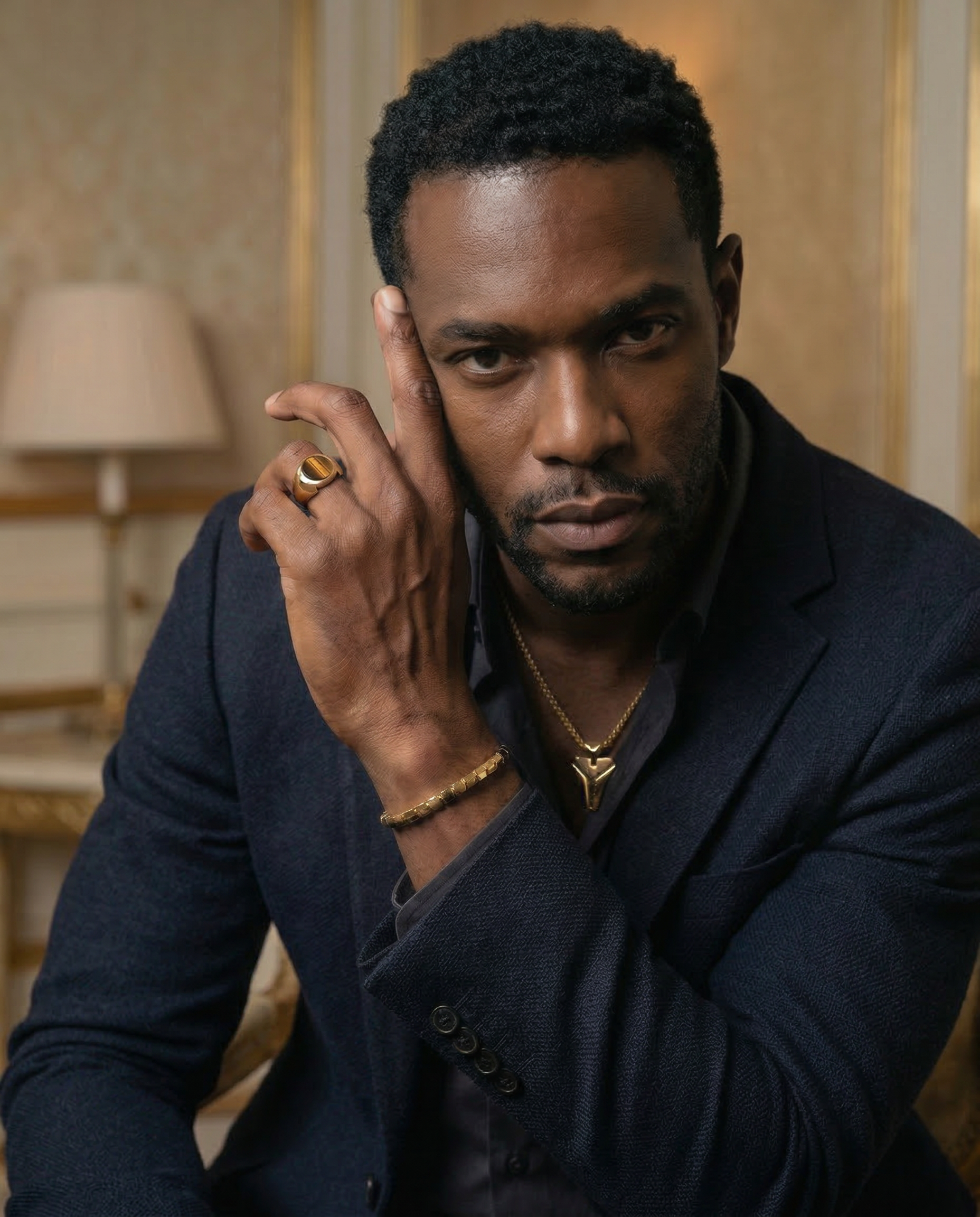
Mixing gold and silver can work, but it requires a level of confidence most men have not earned yet. When in doubt: one metal, many textures. silver with matte lava stone with polished onyx. Or 24k gold with tiger eye with a black accent. The texture does the talking.
The exception: A single contrasting metal accent — a single gold bead on an otherwise silver stack, for instance — reads as deliberate. Two competing metals read as confusion.
Two bracelets look like you could not decide. Four look like you are counting. Three is the magic number — and five works if you have the wrist for it. Odd numbers create visual asymmetry, which your eye reads as more natural and less staged.
This is not mysticism. It is composition. Photographers use the rule of thirds. Architects use odd-numbered window groupings. Fashion designers cluster accessories in threes. Your wrist is a small canvas, but the same principle applies.
The practical test: If your stack looks “too much” and you cannot figure out why, remove one piece. If it still looks off, add one back and remove a different one. Almost always, the problem is an even count.
The most common question in men's stacking: which wrist gets the bracelets if one wrist already has a watch? Answer: the same wrist. Splitting jewelry across both wrists dilutes the visual impact and makes you look like you are wearing two different outfits from the elbows down.
The technique: leave a small gap between the watch and the first bracelet. Not an inch — just enough that they do not constantly clank against each other. The watch is the anchor (Rule 01). The bracelets stack below it, moving toward the hand.
The one exception: If you wear a dress watch — thin, elegant, minimal — it may be better to keep that wrist clean and stack the other. Dress watches are designed to disappear. Bracelets are designed to be noticed. They do not always coexist well.
The most sophisticated stackers are not the ones who wear the most. They are the ones who take one piece off before they leave the house. The stack should feel edited, not accumulated. Every piece should earn its place.
Coco Chanel's advice — look in the mirror and remove one thing — was never about women's jewelry specifically. It was about restraint as a form of confidence. The man who wears three pieces because he chose three, not because he owns three, projects something entirely different from the man whose wrist is a showcase of everything he has ever bought.
The test: If you cannot explain in one sentence why a piece is in the stack, it does not belong there today. “Because it looks good” is not a reason. “Because it grounds the texture contrast” or “because the onyx anchors the lighter pieces” — that is a reason.
Putting It All Together
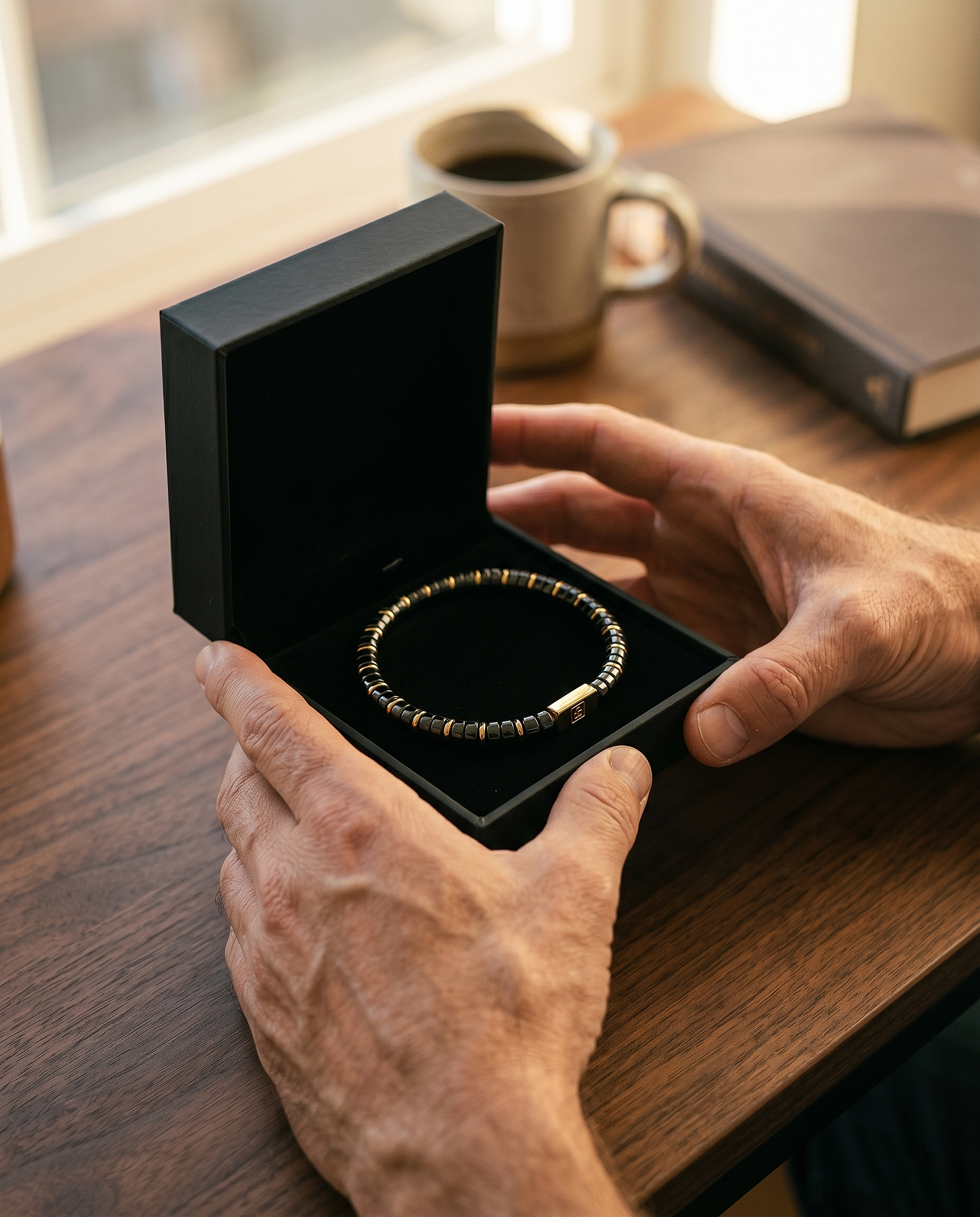
Here is a practical starting stack for a man who owns three Seekers pieces:
2. A tiger eye or natural stone bracelet for texture contrast (warm, striated).
3. A silver chain or 24k gold cuff for metal presence (sharp, clean).
That is it. Dark anchor, warm middle, sharp accent. Three textures, one metal family, odd count. Every rule applied without overthinking it.
As you grow the collection, you can experiment. A fourth piece — a leather wrap, a thinner bead bracelet — can work if the anchor is strong enough to hold the composition. A fifth requires a confident wrist and an eye for proportion. Beyond five, you are no longer stacking. You are collecting.
The Deeper Point
Stacking is not really about jewelry. It is about curation — the same skill that makes a man's wardrobe feel intentional instead of random, his bookshelf feel curated instead of cluttered, his home feel considered instead of decorated.
Every piece you add to the wrist is a small decision about who you are presenting to the world today. The morning stack — picking the right pieces for the right day — is a quiet act of self-definition that most men never realise they are performing.
Start with three. Apply the rules. See what happens.


Leave a comment
This site is protected by hCaptcha and the hCaptcha Privacy Policy and Terms of Service apply.